
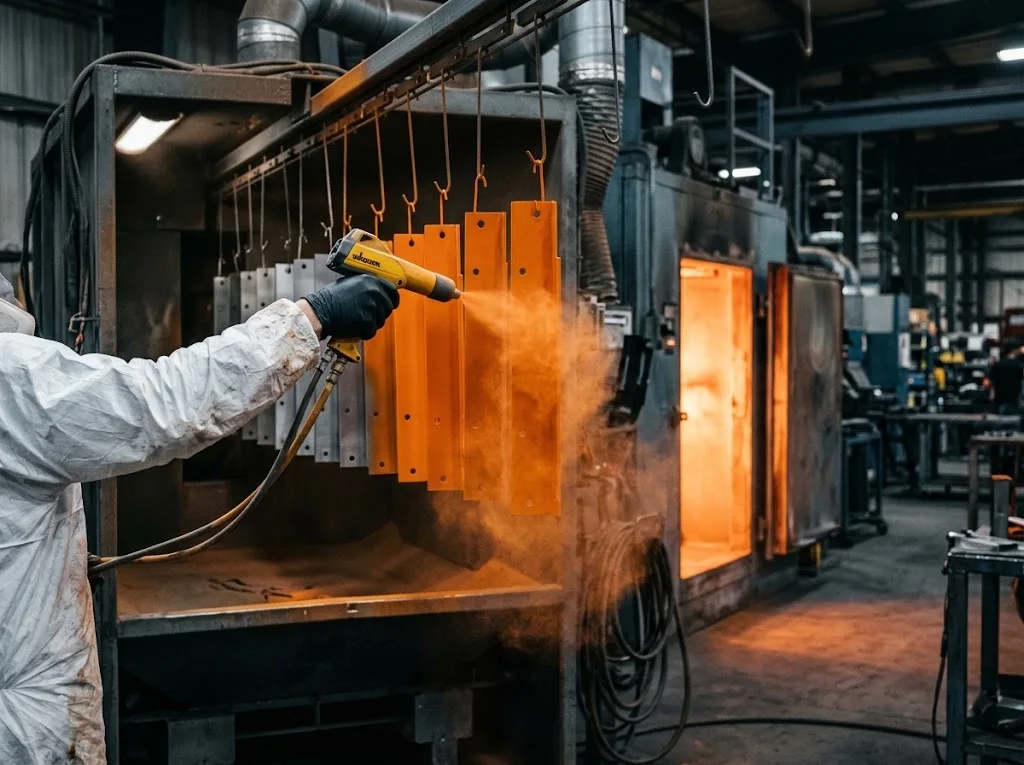
Powder coating requires strict adherence to process parameters and properly working equipment. Any deviation in the spray gun settings, grounding or powder quality has a negative effect on adhesion and layer uniformity.
This article looks at the three most common defects in automatic and manual spraying, their causes and effective solutions for optimising production.
1. Poor adhesion: the powder does not stick to the part or falls off easily
A common situation where the workpiece is not coated at all, gets only a thin layer, or the powder dust falls off before curing.
Possible causes:
- Spray equipment malfunction: damage to the high-voltage power unit, failures of the controller circuit board.
- Grounding problems: no proper electrical contact with the workpiece because of dirty hangers.
- Wrong spray parameters: voltage, current or powder feed too high or too low for the specific type of product.
- Incorrect distance: the gun is too close to or too far from the workpiece.
- Low-quality powder paint: increased moisture in the mixture, foreign metal particles or too high a specific gravity (which reduces first-pass transfer efficiency).
- Excessive airflow: exhaust ventilation in the spray booth is too strong and blows the powder off the surface.
Recommended solutions:
- Technical diagnostics: carefully check the integrity of the spray gun's high-voltage circuits and the electronic control unit.
- Cleaning grounding elements: regularly clean baked-on paint and insulating deposits off the contact points of hooks and clamps.
- Calibrating parameters: adjust voltage and current to the type of material. Modern spray guns with saved presets (programmes) are recommended.
- Adjusting the distance: set the optimal distance from the nozzle to the part, taking into account the spray pattern geometry and powder output.
- Equipment and powder care: regularly clean accumulated dust off the outside of the gun and the powder hoses; check that the powder is dry and has the right specific gravity.
- Optimising pneumatics: adjust the compressed air pressure and the airflow speed in the spray booth.
2. Poor coverage in hard-to-reach areas: the “Faraday cage” effect
A situation where recesses, corners, grooves or the inner bends of a part get no powder at all or only a thin, incomplete layer.
Possible causes:
- Incorrect current and voltage settings: too high a potential creates back-ionisation or strengthens the Faraday cage effect, pushing particles out of corners.
- Insufficient gun performance: the equipment does not provide enough penetration of the spray pattern.
Recommended solutions:
- Setting special modes: reduce the voltage and increase the air supply (or switch the spray gun to the mode for complex parts/recoating). Save the tested parameters in the controller's memory.
- Upgrading equipment: replace the gun with a more efficient high-voltage model with better transfer efficiency and flexible electrostatic control.
3. Uneven coating in automatic application
When automatic manipulators or robots are used, the powder layer ends up unevenly thick across the workpiece.
Possible causes:
- Incorrect hanging of parts: workpieces are placed at different angles or at different distances from the automatic gun, so the spray pattern covers them unevenly.
- Wrong flow rate or nozzle: the nozzle type or powder feed volume does not match the conveyor speed and the product dimensions.
- Incorrect gun positioning: wrong tilt angle, height or number of active automatic guns.
Recommended solutions:
- Standardising racking: adjust the hanging system so that all identical parts are fixed in exactly the same position.
- Adjusting nozzles and flow rate: reduce the powder feed volume or replace the nozzle with a type that gives the required pattern width and density.
- Aligning the automatic system: adjust the number of guns, their movement path (the manipulator's working stroke), their position and tilt angles relative to the conveyor line.
Conclusions
Most powder coating defects come down to three factors: stable grounding, compressed air/powder quality and correct electrostatic settings. Modern equipment with automatic spray programmes keeps rejects to a minimum and ensures consistent coating quality.